Analytical material
The streets of Romania’s capital preserve architecture from an era when European cities were embracing new artistic movements. Geometric ornament, stepped façades, elegant balconies and strong vertical lines became recognisable features of Art Deco, which spread through Romania in the 1920s and 1930s. Almost a century later, interwar buildings still shape Bucharest’s distinctive appearance. For visitors, this heritage offers a way to discover the city through European art history, local traditions and the surviving work of outstanding architects.
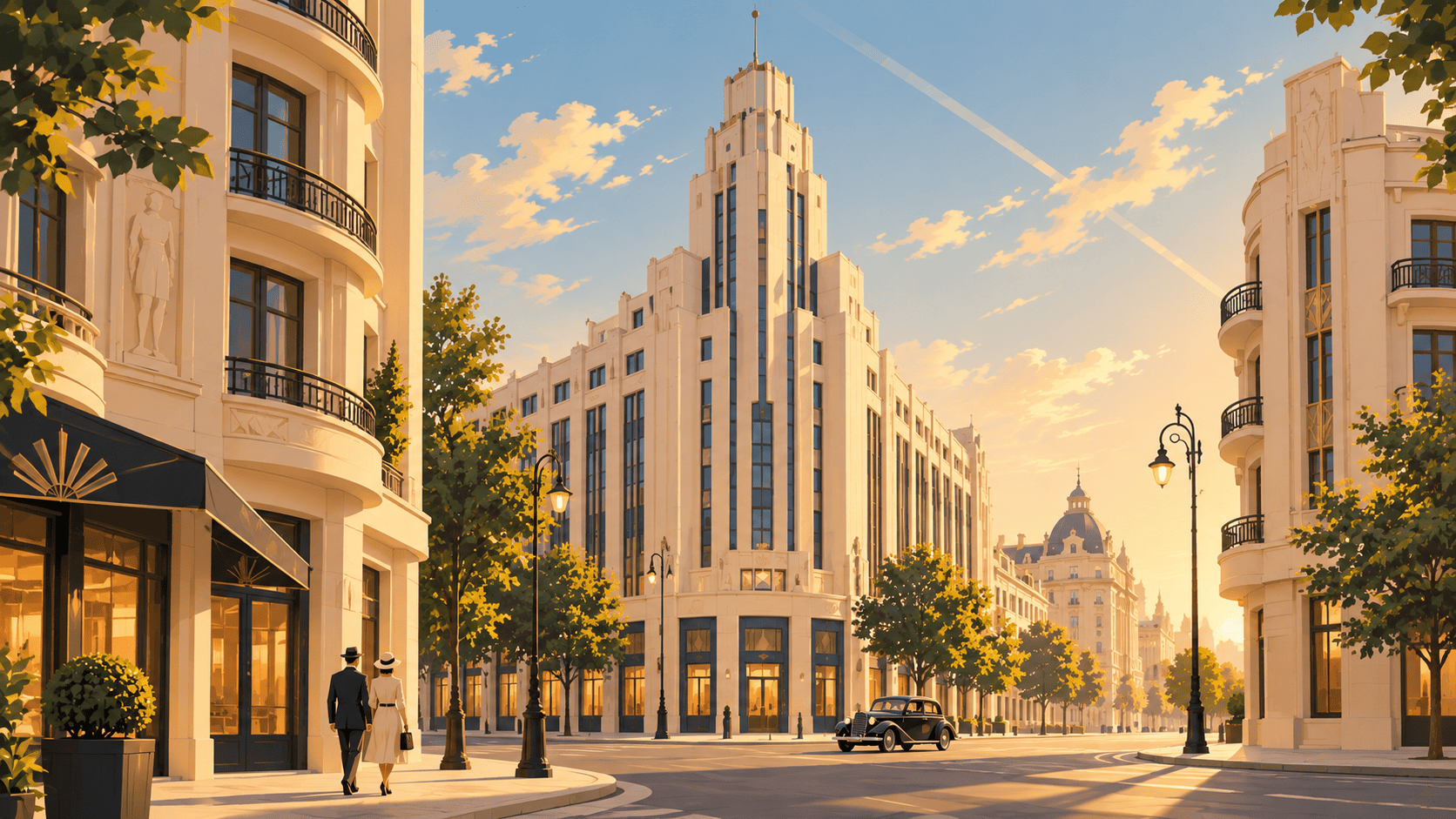
The illustration evokes the atmosphere of the period and is not a photograph of a particular building.
How Art Deco came to Bucharest
The style’s history begins in France in the early decades of the twentieth century. The movement developed through decorative arts, the geometric experiments of the avant-garde and an interest in new materials. It gained international recognition after the 1925 International Exhibition of Modern Decorative and Industrial Arts in Paris, where artists and architects presented work combining traditional craftsmanship with modern forms. The exhibition’s name later provided the basis for the term Art Deco.
The aesthetic sought to unite beauty and functionality. Design gradually moved away from the elaborate plant motifs associated with Art Nouveau. Architects favoured symmetry, repeated geometric shapes, expressive silhouettes and decorative details that emphasised a building’s structure. Stepped rooflines, projecting vertical elements, stylised sunbursts and rhythmic linear ornament became particularly important.
The movement quickly spread beyond France, with distinctive interpretations appearing in Britain, the United States and other European countries. Parisian decorative traditions met the aesthetic of American skyscrapers, the growth of cinema and new ideas about comfort. The style became an artistic language for an entire era, extending across architecture, interiors, furniture, graphic design and fashion.
New ideas reached Bucharest primarily through its artistic community. An important event was the opening in 1926 of the permanent salon of decorative art for the modern interior, known as Salonul permanent de artă decorativă pentru interiorul modern. Participants included M.H. Maxy, Mattis-Teutsch, Nina Arbore, Iorgulescu-Yor, Jean Al. Steriadi and Corneliu Michăilescu. Exhibitions introduced the city’s public to modern decorative forms, which gradually entered everyday interiors.
The architecture of interwar Bucharest
In the late 1920s, artistic experimentation continued in architecture. Buildings appeared along central streets with concise geometric façades, distinctive corner compositions and decoration that differed from earlier traditions. Hotels, cinemas and apartment buildings underwent particularly noticeable changes.
Arghir Culina and Hotel Negoiu
Arghir Culina played a significant part in developing this new architectural language. The Romanian architect worked in several styles before gradually turning towards Art Deco. Hotel Negoiu, originally known as Hotel Stănescu, appeared in 1929. On Ion Câmpineanu Street, its design combined modern geometric compositions with elements of the Neo-Romanian tradition. This synthesis expressed a characteristic feature of Bucharest’s architecture: international trends acquiring a local artistic identity.
Hotel Union
Hotel Union, built in 1931, continued this architectural exploration. Culina gave the building a striking stepped composition resembling a compact skyscraper. Vertical decorative elements emphasised the height of its central section, while successive setbacks on the upper floors created its distinctive silhouette. The building demonstrated how rhythm and geometry could transform familiar urban forms.
Palatul Telefoanelor
The Telephone Palace on Calea Victoriei occupies a special place in the capital’s architectural history. Its formal opening took place on 24 April 1933. American architect Louis Seabury Weeks developed the design, while Romanian architect Edmond Van Saanen Algi participated in its execution and detailed development. The high-rise became one of interwar Bucharest’s most recognisable architectural symbols. Its strong verticality, narrow rows of windows and geometric treatment of the upper section reflect the influence of early twentieth-century American architecture. The building is particularly striking against the surrounding historic streetscape. The coexistence of different artistic eras makes changes in architectural thinking visible along a single street.
Hotel Lido
By the 1930s, Art Deco had become firmly established in the Romanian capital. It extended beyond individual buildings into the design of public spaces. Hotel Lido, designed by Ernest Doneaud, became part of a modern culture of urban leisure. Its artificial-wave swimming pool, opened in 1930, and nearby entertainment spaces reflected contemporary enthusiasm for comfort, sport and social life.
The palace on Batiștei Street and Hotel Ambasador
Another distinctive example was the palace of the Municipal Employees’ Society at 14 Batiștei Street, built in 1932–1934 by architects Ioan C. Roșu and Radu Culcer. The composition combined geometric volumes with an elaborate interior plan, including halls for celebrations and cultural events. It demonstrated the style’s potential in the design of public institutions. Towards the end of the decade, Art Deco became more restrained while retaining its interest in verticality and expressive proportions. This tendency can be seen in Hotel Ambasador, opened on 4 May 1939 on Magheru Boulevard. Arghir Culina’s design continued the development of Bucharest’s hotel architecture. Its regular window rhythm and monumental silhouette reflect the transition towards late Art Deco, closely connected with Modernism.
By the end of the 1930s, a distinctive architectural environment had emerged, bringing together French decorative traditions, American high-rise compositions and the work of Romanian architects. This stylistic variety became a characteristic feature of Bucharest that remains historically significant today.
Bucharest’s heritage as a visitor attraction
Interest extends beyond the best-known architectural landmarks. Ordinary residential buildings with surviving original decoration form a substantial part of the historic environment. Their façades display stylised plant motifs, geometric reliefs, narrow vertical windows and metal balcony railings. Entrances framed in stone, decorative doors and compositions emphasising stairwells deserve particular attention.
These details make the city feel like a collection of architectural works. Even modest houses can contain features associated with European interwar artistic movements. Geometric façades recall the French school, while the curved lines of corner balconies and horizontal windows relate to the ocean-liner aesthetic popular in the 1930s.
Art Deco buildings in European capitals
The figures were checked for October 2026. The absence of a consolidated figure means that no verified citywide count was found in the sources consulted — it does not mean that buildings in this style are absent.
These figures come from different kinds of sources: inventories, research maps, individual housing ensembles and guidebook selections — they cannot be directly compared as complete citywide totals.
| Capital | Number | Basis and source |
|---|---|---|
| Brussels | More than 1,900 | Art Deco building records in the official inventory of the Brussels-Capital Region |
| Bucharest | More than 450 | Art Deco and Deco Modernist properties mapped by the B:MAD project by 2020 — a professional research database |
| Prague | 63 | Homes in the Domov housing ensemble, according to the official city tourism portal — not a citywide total |
| London | More than 70 | Selected buildings in the Blue Crow Media architectural map — an independent guide |
| Paris | 50 | Buildings included in the specialist architectural map published in 2025 — an independent guide |
| Berlin | No consolidated figure | |
| Madrid | No consolidated figure | |
| Amsterdam | No consolidated figure | |
| Budapest | No consolidated figure | Individual buildings are described by the Budapest100 architectural project, but no overall count was found |
| Riga | No consolidated figure | The city museum mainly documents Art Nouveau rather than Art Deco |
| Helsinki | No consolidated figure | The municipal tourism resource mainly provides information about Art Nouveau |
Discover Romania
Bucharest preserves the history of Art Deco in its elegant balconies, geometric façades and interwar silhouettes. The capital’s architectural heritage reveals only part of Romania’s cultural richness. Come and walk through its historic streets to discover the beauty that photographs cannot fully convey. Getting to know Romania begins with a journey!
Bibliography
- Blue Crow Media. (n.d.). Art Deco London Map
- Blue Crow Media. (n.d.). Art Deco Paris Map / Carte Paris Art Déco
- Criticos, M. (2007). Bucureștiul interbelic: O capitală Art Deco. In București Stop Cadru! Despre atmosferă prin arhitectură și urbanism (pp. 55–74). Editura Universitară Ion Mincu
- Dogaru, D., Criticos, M., & Ciocăzanu, A. (2020). B:MAD București / Bucharest: Modernism Art Deco 1920–1945. Anuala de Arhitectură București
- Prague City Tourism. (n.d.). Walk through lower Žižkov
- Urban.brussels. (2025, November 20). Focus on Art Deco #06: Petit patrimoine, l’Art Déco du quotidien