Analytical material
How Bucharest became one of the most interesting coffee cities in Europe
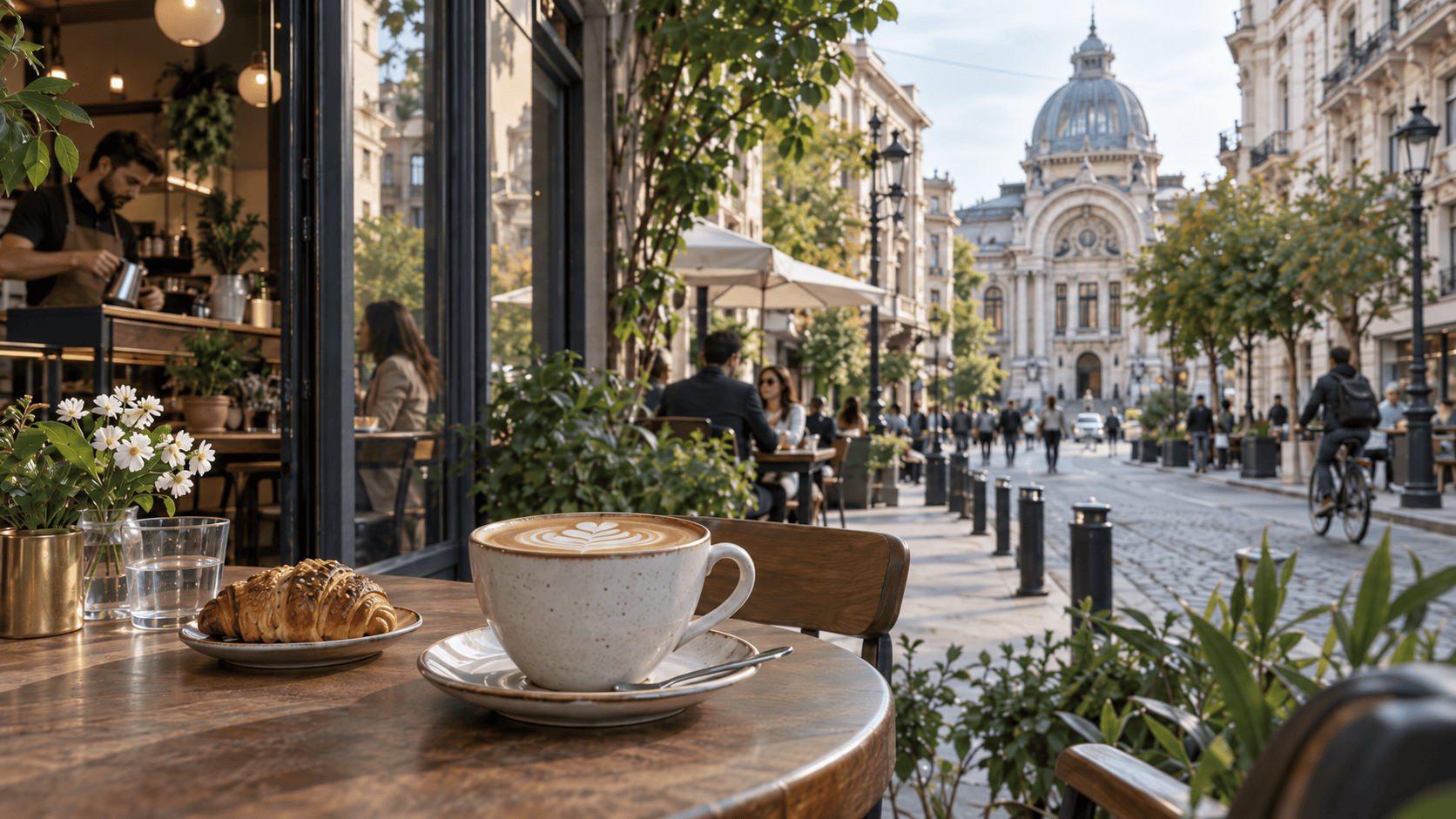
The European Coffee Trip guide to Bucharest features more than one hundred specialty coffee addresses. The scale of the selection makes it possible to build an entire walk around coffee. Instead of one mandatory stop, visitors can discover different roasters and different types of coffee shops.
Behind the modern coffee map lies a history of more than three centuries. Historical research describes Ottoman coffeehouses in the seventeenth century and literary gatherings in the nineteenth century. Reports from recent years already focus on professional roasting and international competitions. An interesting connection exists between the old coffeehouse table and the modern coffee bar: the habit of meeting over a cup has acquired new meaning.
Coffee arrived long before coffee shops became fashionable
The first documented coffeehouse in Bucharest dates to 1667. The establishment was opened by a Turk named Haime. In the eighteenth century, the city coffeehouses followed the international model of the period and often appeared near the route used by arriving merchants. Coffee entered urban life through trade links and everyday contact.
Coffee was also valued at the princely court. An entry in the treasury records of Constantin Brâncoveanu mentions the arrival of approximately 19 kilograms of coffee on 7 July 1696. By the end of the eighteenth century, the ruler maintained a special court position connected with coffee preparation. Constantin Gabriel of the Bucharest Municipality Museum discusses the details in an article for Historia.
The coffee history of the Romanian capital did not begin with an imported fashion of recent decades. Coffee had a place in city life long before modern coffee machines appeared. The old habit of drinking coffee does not by itself explain the emergence of the modern specialty coffee industry. The new culture required separate entrepreneurial initiatives and professional knowledge.
When literature was discussed over coffee
In the nineteenth century, coffeehouses in Bucharest differed considerably from one another. In 1841, the traveller Domenico Zanelli described Ottoman style establishments existing alongside cafés that offered newspapers and billiards. The European format introduced spacious rooms with mirrors and changed the setting of the traditional meeting. According to a historical article by Andra Frățilă, the statistical dictionary compiled by Dimitrie Frunzescu in 1872 counted one hundred large and small coffeehouses in the capital.
People gathered over coffee for more than the drink itself. The Fialkowski coffeehouse near the National Theatre square welcomed the writer Ion Luca Caragiale. The writer Duiliu Zamfirescu was also among the visitors. Other establishments became regular meeting places for merchants. Different coffee addresses developed for different social circles. A modern coffee walk becomes more interesting when such history is part of the experience.
Casa Capșa
Casa Capșa on Calea Victoriei deserves a chapter of its own. The family confectionery opened in the middle of the nineteenth century and gradually became a well known meeting place for the cultural community of the capital. The history of the establishment preserves the names of visitors from the worlds of theatre and literature. Confectionery became closely connected with the public life of the city. In an interview with Radio Romania International, Casa Capșa representative Mirona Noru spoke about the Joffre dessert, created by the team in 1920 in honour of Marshal Joffre. One detail matters: authorship cannot automatically be attributed to Grigore Capșa. The founder died in 1902, while the fame of the name later created confusion. A stop near Casa Capșa adds historical depth to a coffee journey. The point is not to search for a modern filter coffee in a historic interior, but to understand the story of a meeting place. A historic confectionery and a specialty coffee bar do not need to compete. The appeal of the walk comes from the contrast between the experiences.
When coffee became scarce
Romanian coffee history also includes difficult periods. During the 1980s, shortages contributed to the spread of nechezol, a coffee substitute. The Museum of Memories from Communism in Brașov used the drink in a project collecting personal stories, inviting visitors to share memories over a cup of coffee. The Rador agency reported on the project in 2023.
After 1989, a new stage of consumer life began. Access to foreign products, however, cannot be equated with the immediate birth of specialty coffee culture.
A new beginning: curiosity instead of habit
In December 2012, Antonio Iftimescu opened Coftale together with his sister Roxana Dobre. According to Fresh Cup, the founder became more interested in coffee preparation after experiencing a good cappuccino in Berlin. Further professional training helped turn curiosity into a business.
In 2013, Mihai Panfil opened Origo. The team focused not only on preparation but also on helping guests understand coffee. In the original version of the space, visitors could watch the roasting process through glass. Working with coffee beans stopped being a hidden part of restaurant operations and became a subject of interest in its own right. A European Coffee Trip report published in January 2016 shows the diversity of the early scene. Origo stood out to the author because of detailed conversations with baristas about coffee origin. At the small Steam coffee shop, quick coffee before work played an important role. Frudisiac attracted visitors with Scandinavian design and the combination of coffee and breakfast. The new direction developed in several formats at once rather than following a single café model.
Educational work continued through the Barista Academy at Origo. The official website lists a dedicated training space in Bucharest. The educational component helps explain the difference between opening an attractive venue and developing a profession: consistent quality requires trained people.
Attention to detail lies behind the term specialty coffee
The term can easily be mistaken for the name of a fashionable interior style or a complicated brewing method. The Specialty Coffee Association defines the concept differently. The association links specialty coffee to distinctive characteristics and greater product value. Flavour characteristics can matter, along with the origin of the beans and the story of production. In practical terms, attention shifts from coffee as an abstract product to a specific coffee. A conversation about taste naturally leads to questions about origin. The work of the roaster helps reveal the character of the beans, while preparation determines the result in the cup. Attractive tableware alone is not enough for a meaningful introduction to coffee. A modern approach does not require abandoning the cezve. The World Coffee Championships system includes a separate Cezve/Ibrik Championship dedicated to the traditional brewing method. Organisers emphasise the cultural heritage of the method. A traditional tool can remain part of a modern professional conversation.
International recognition begins with professional work
In 2016, Romanian roaster Alexandru Niculae won the World Coffee Roasting Championship in Shanghai. The victory is recorded in a World Coffee Events announcement published by Comunicaffe International. Romania received a clear demonstration of professional recognition within international coffee culture.
The roasting championship evaluates work with green coffee, roast planning and the quality of the final coffee. A victory of this kind gives international recognition a concrete basis: successful performance depends on skills that shape flavour before brewing even begins. In August 2017, Niculae opened Bob Coffee Lab together with Paul Ungureanu. A European Coffee Trip report describes the project as a combination of coffee shop and roasting space. The founders aimed to develop the team through training and regarded attentive service as an important part of a high quality coffee experience. An interview with Niculae for TYPICA preserves another interesting detail. The compact coffee shop was connected to the roasting room through round windows. Open windows allowed visitors to watch the work and smell the roasting coffee. Professional craft gained a visible continuation in an ordinary café visit. For a visitor to the city, the value of projects like this lies in the opportunity to come closer to the craft. An award attracts attention, but the story of coffee processing helps explain the substance behind the achievement. The journey becomes more interesting through access to knowledge rather than through a photograph beside a famous sign.
Why coffee shops began appearing more quickly
In April 2018, European Coffee Trip described the rapid growth of the Bucharest scene: the number of specialty coffee locations known to the publication had increased from eleven to more than fifty in less than two years. The journalist connected this development with knowledge sharing among the first generation of baristas and professional trips to the United Kingdom and Germany. The connection between coffee and other forms of urban culture is visible in the story of Artichoke. Cofounder Diana Angel worked in photography, while the coffee shop was used to introduce visitors to local artists. The report mentions work by illustrators from the team. A cup of coffee became a reason to stay for the art, while an exhibition became a reason to stop for coffee. Stories of this kind link growth with a combination of professional training and interest in urban culture. International experience provided tools, while local entrepreneurs found practical ways to apply them. The Bucharest scene developed character through different approaches rather than uniformity.
The Romanian story does not end in the capital
It would be inaccurate to treat Bucharest as the only source of modern Romanian coffee culture. Meron, a company based in Cluj, describes its own roasting work in Transylvania. The official website presents coffees from different origins intended both for coffee shops and for home preparation.
For travellers, this example expands the geography of interest. Discovering coffee shops in the capital can become the beginning of an interest in Romanian roasters outside Bucharest. National coffee culture is also developing beyond the capital. Bucharest offers a convenient starting point, while the next stage can justify a separate trip. The nature of Romanian participation in the international industry is also changing. In an interview with European Coffee Trip published in August 2026, Alexandra Sturdza discussed work on the Romanian project Oddly Specific. The company presented the Snap™029 brewing device at World of Coffee in Brussels. The professional path of Sturdza began with work at Origo during university studies. Barista training and quality focused work followed, with later involvement in a product project. The story illustrates a possible path through the industry: experience behind the bar can become a foundation for teaching and the development of new equipment. Romania participates in the international coffee conversation not only through coffee shops but also through professional products.
Coffee moves beyond the coffee shop
Bucharest hosts COFFeEAST, a festival dedicated to coffee culture in Eastern Europe. The programme combines a professional exhibition with events for coffee enthusiasts. Roasters appear alongside representatives of the equipment industry and creative professions, while tastings and educational meetings extend the experience. The festival format offers an important advantage for travellers: a single visit can provide exposure to several approaches to coffee and direct conversations with industry participants. A trip built around the event should be planned according to the current programme published by the organisers.
One day in Bucharest through coffee
A coffee walk can begin at Origo, Strada Lipscani 9. The address appears on the official project website. A conversation about the available beans and brewing method provides a useful first introduction. Instead of feeling obliged to order the most unusual drink, choosing a clear reference point makes later comparison easier.
A historical stop can be made at Casa Capșa on Calea Victoriei. The connection between the confectionery and the memory of the city deserves attention. The walk can continue to Artichoke at Calea Victoriei 45, listed in the current European Coffee Trip directory. The historical story then gives way to the contemporary urban environment. The route does not need to become a competition based on the number of cups consumed. Time for walking and lunch is worth keeping between stops. Opening hours should be checked directly with each venue before visiting because schedules and menus can change.
For the student community, the coffee culture of the city can become a reason to discover Bucharest beyond university walls. A small meeting in a coffee shop can become a conversation club for practising Romanian, while a walk through historic addresses can bring local and international students together. A university association can be approached with the idea of a joint event. Coffee culture can also provide material for a student project. For marketing students, analysing the promotion of a small roasting company can become a useful assignment. Research can begin with an interview with the founder, allowing entrepreneurial experience to be compared with theory from university courses. The collected material can then support an article for student media. Urban history offers another direction: a student organisation can develop a coffee route with commentary based on verified sources. The main opportunity lies not in the number of coffee shops visited, but in moving from observing the city to participating in city life. An introduction to Romania can begin with a conversation over coffee, continue with a meeting with a local entrepreneur and develop into a joint educational project. Bucharest becomes not only a place to study but also a space for early professional experience. The value of such experience depends not on the prestige of a coffee shop but on the quality of communication and the results of collaborative work.
Bibliography
- Titles of foreign language articles are presented in English translation.
- Constantin Gabriel. Coffeehouses of Old Bucharest and Their Period of Prosperity. Historia. The author represents the history department of the Bucharest Municipality Museum. The publication date is not indicated on the page.
- Frățilă, A. Coffeehouses of Old Bucharest in the Nineteenth and Twentieth Centuries. Historia. The publication date is not indicated on the page.
- Fenogen, A., Cononovici, A. M. Stories from Casa Capșa. Radio Romania International. 29 April 2025.
- Museum of Memories from Communism. Nechezol in Exchange for a Story: A New Campaign to Collect Memories from the Communist Period. Museum announcement published by the Rador agency. 8 February 2023.
- Kelly, S. Coffee Shop Tour: Coffee in Bucharest. Fresh Cup. 5 September 2017. Updated 17 August 2022.
- Kamaradova, K. Discovering the Young Coffee Scene of Bucharest. European Coffee Trip. 7 January 2016.
- World Coffee Events. The 2016 World Coffee Champions Announced. Competition organiser announcement published by Comunicaffe International. 8 April 2016.
- Zivkovic, L. Bob Coffee Lab: The Champions Coffee Shop and Roastery in the Heart of Bucharest. European Coffee Trip. 29 September 2017.
- TYPICA. Going Beyond Familiar Boundaries on a Great Coffee Journey. Interview with Alexandru Niculae, Bob Coffee Lab. Publication date not indicated.
- Zivkovic, L. Bucharest Is Becoming a World Class Specialty Coffee City. European Coffee Trip. 4 April 2018.
- Galecki, L. Barista Stories: Alexandra Sturdza of Oddly Specific and Bandit, Bucharest. European Coffee Trip. 27 August 2026. Official and reference materials
- Specialty Coffee Association. What is Specialty Coffee. Official explanation of the specialty coffee concept.
- World Coffee Championships. Cezve/Ibrik Championship. Official competition page.
- Origo Coffee. Contact. Coffee shop addresses and Barista Academy.
- Meron. Our Story. Official information about the project and roasting operation.
- COFFeEAST. Official website of the Eastern European coffee culture festival.
- European Coffee Trip. Guide to specialty coffee shops in Bucharest.
- European Coffee Trip. Artichoke Coffee Shop. Venue listing with address. Electronic sources accessed on 23 September 2026.
Author: Manfred · Editor: Polina